
The jaw joint is the busiest
moving joint in the human body
It is the only bilateral joint that moves constantly when talking, eating, and yawning.
A problem with the jaw joint is a problem with the balance of the entire body.
Why is the jaw joint important?
It is not just simple pain. Anatomically, it is a key strategic hub that affects the entire body.
Average 3,000 movements per day
It is the only bilateral joint
that moves constantly not only when chewing and talking
but also while sleeping.
Hub of the Central Nervous System
9 out of the 12 cranial nerves
have branches passing around the jaw joint.
Jaw pain disrupts the nervous system.
Starting Point of Spinal Structure
The 1st and 2nd cervical vertebrae are connected to 136 muscles
and move organically with the jaw joint.
It is a direct cause of systemic spinal changes.
How does TMD begin?
It worsens progressively through a complex combination of malocclusion, trauma, stress, poor posture, and bad oral habits.
Initial Irritation
Excessive pressure is applied to the jaw joint
due to chewing on one side, teeth grinding, stress, etc.
Disc Displacement
The disc, which should be in its normal position,
slips out forward (Disc Displacement).
Structural Wear
The disc wears down due to the misaligned jaw joint,
and the surrounding muscles become hyper-tense.
3 Major Symptoms of TMD
If any of these three apply to you, treatment is necessary.

01. Jaw Joint Pain
01. Jaw Joint Pain
Pain is felt around the jaw
or in front of the ear
when opening or closing the mouth.

02. Jaw Joint Sounds
02. Jaw Joint Sounds
A 'clicking' joint sound or
a crepitus sound like grinding sand
can be heard.
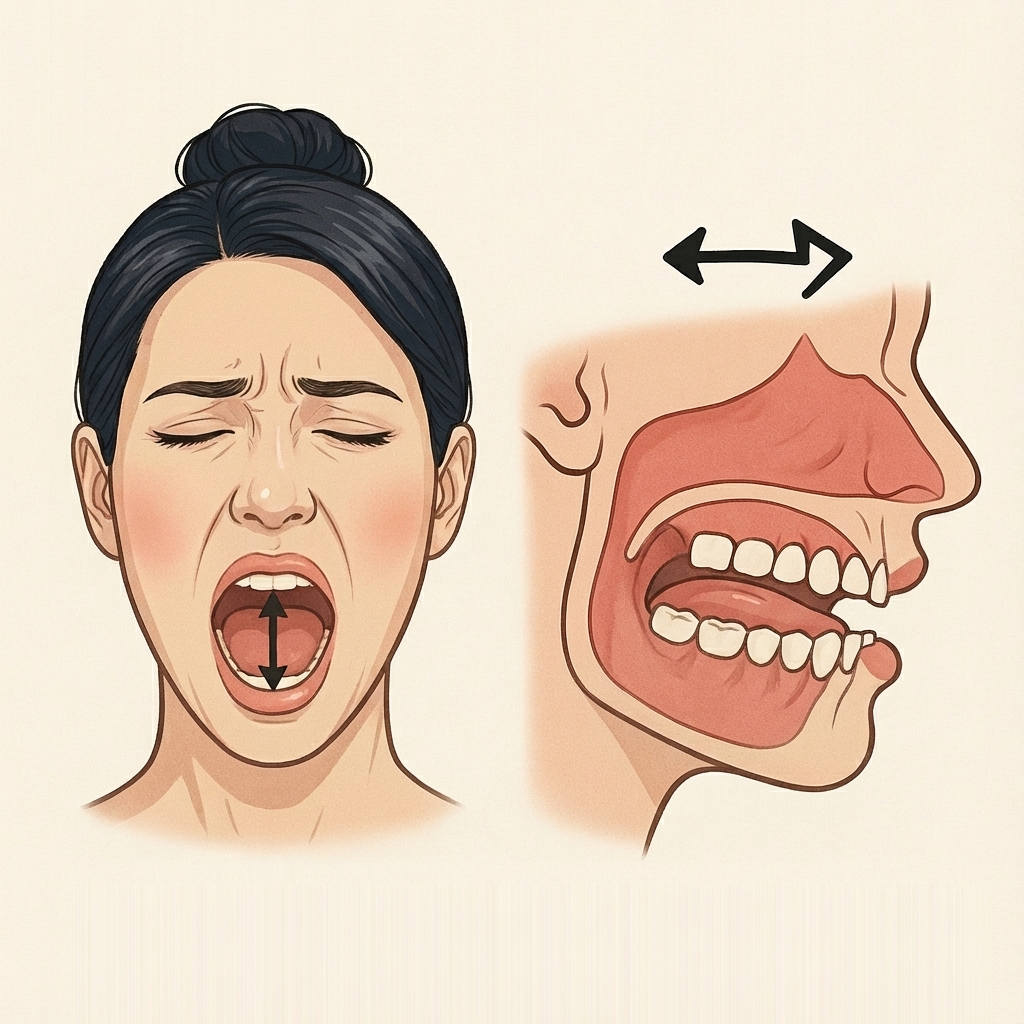
03. Difficulty Opening
03. Difficulty Opening
The mouth does not open wide
(less than 40mm),
or opens in a zigzag pattern.

5 Reasons Why You Must
Treat TMD
This is why you should not ignore it even if symptoms seem mild.
Type & Classification
From the acute phase limited to the jaw to the chronic phase spread to systemic diseases
Acute Type 1
Stage limited to the jaw joint itself.
Symptoms include jaw pain, difficulty opening, zigzag movement,
crepitus, and subluxation of the jaw.
Acute Type 2
Symptoms spread to areas adjacent to the jaw joint.
Accompanied by headaches, migraines, dizziness, trigeminal neuralgia, toothaches,
neck/shoulder pain, tinnitus, and eye fatigue.
Chronic Type 1
Collapses spinal structure and spreads to systemic pain diseases.
Cervical/lumbar discs, scoliosis, straight neck,
and pelvic misalignment occur.
Chronic Type 2
Worsens into central nervous system disruption and chronic intractable diseases.
Nervous system problems such as chronic headaches, dizziness, chronic fatigue, depression, insomnia,
tics, and Tourette's appear.
Neurological Cycle of Deterioration
The process by which it spreads to systemic symptoms when it moves beyond the acute phase to a chronic state.
The jaw shifts to one side and
moves away from its centric position.
The 1st and 2nd cervical vertebrae,
which are the axis of the jaw joint, are twisted.
Blocks the foramen magnum
causing intractable diseases.

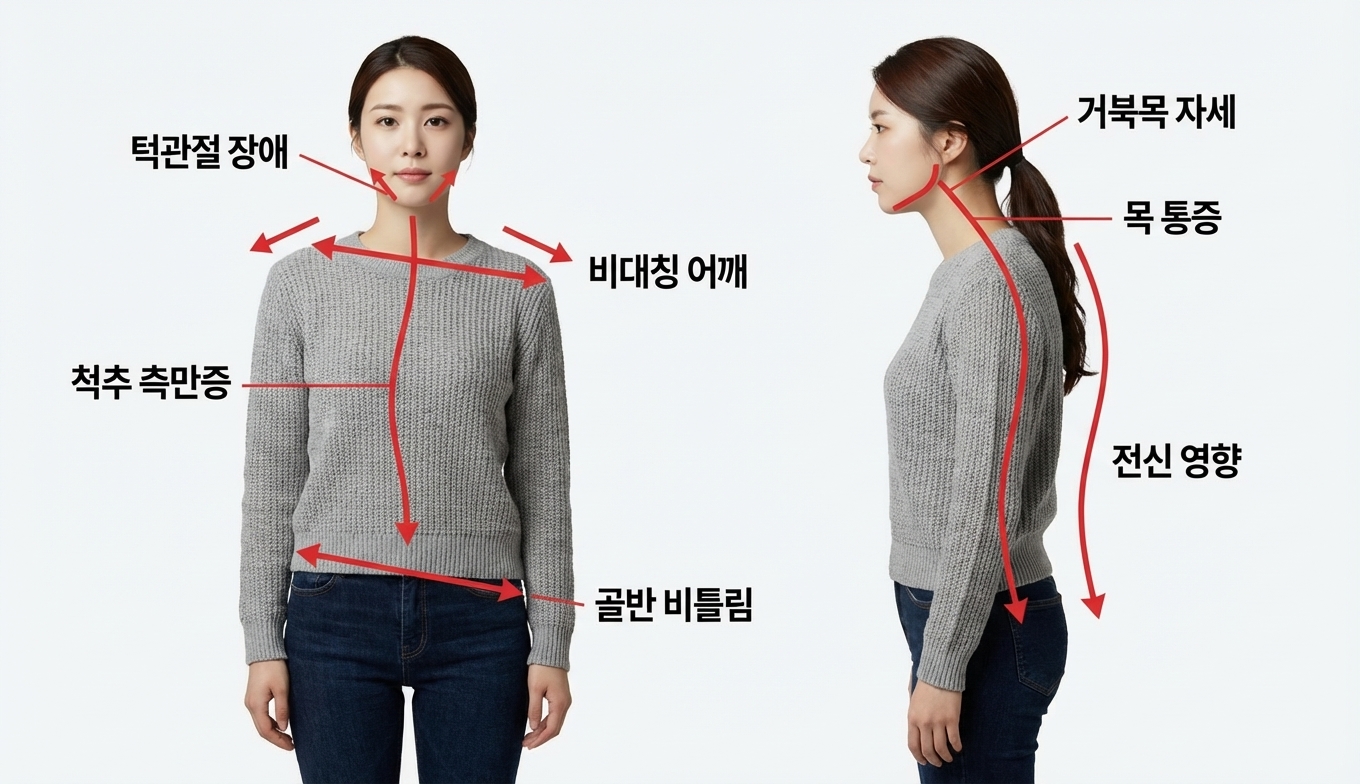
Abnormal Jaw Joints and
Spinal Imbalance
When the jaw joint disc slips out and the central axis is misaligned,
our body compensatorily twists the spine to maintain balance.
This leads to a collapse of the entire body posture, such as
flat back, scoliosis, and pelvic imbalance.
Jaw joint treatment is the beginning of spinal balance treatment.
3D Simulation Process
The Process of Jaw Imbalance
Shown via 3D Video
Causes of Facial Asymmetry and Spinal Imbalance
Check out the process through 3D simulation to see how
minute jaw imbalances twist the cervical spine and lead to
facial asymmetry and systemic spinal imbalances.
* The jaw joint is not just a joint; it is the key to overall body balance.
Treatment Result Data
Increased Mouth Opening
Reduced Jaw Pain (VAS)
Reduced Joint Noise (VAS)
Before & After
TMD Treatment Cases


